

HubSpot’s Spring Spotlight 2026 includes a wide range of updates across marketing, sales, service, and AI.
That is the good news.
That is where a more grounded view helps.
The challenge is that most teams do not need a bigger list of features. They need clarity. They need to know what matters, what is worth prioritising, and how to approach rollout without creating confusion or unnecessary complexity.
This is where a practical approach matters.

What is HubSpot’s Spring Spotlight 2026?
HubSpot’s Spring Spotlight is a major bi-annual product release event. It brings together some of the most important updates across the platform and signals where HubSpot is heading next.
This year’s release points to a broader shift from a more reactive CRM model to a more predictive, AI-assisted growth system. Across marketing, sales, service, and operations, the focus is increasingly on using specialised AI tools, stronger automation, better data management, and improved customer journey visibility to reduce manual work and improve performance.
That does not mean every team should rush to adopt everything at once.
It means there is now more opportunity to choose the updates that best fit your business goals, your current systems, and your team’s readiness to use them well.
The real question is not what’s new - it’s what matters most for your business
At Lupo, we believe the most valuable way to look at Spring Spotlight is not feature by feature, but business need by business need. The goal is to connect each update to a real operational outcome, then decide what fits your team, your systems, and your current level of readiness.
That matters because the value of a release like this is not in how many updates are announced. It is in how clearly you can identify the ones that will create practical impact.
For one business, that might mean improving pipeline efficiency and sales execution. For another, it might mean building stronger discoverability in the AI age. For others, the opportunity may sit in service delivery, support efficiency, or a clearer rollout path for Responsible AI.
Spring Spotlight 2026 includes more than these examples, but for most teams the most useful exercise is not reviewing every release item. It is understanding which changes are most likely to improve revenue performance, discoverability, and service efficiency in practical terms.
The three themes that matter most
Rather than looking at every release item in isolation, Spring Spotlight 2026 becomes easier to work through when grouped into three core themes:
-
Grow revenue
-
Build awareness
-
Scale support
These themes make it easier to prioritise based on business goals.
HubSpot Spring Spotlight 2026 Reveal
A practical guide: How to implement the right updates into your business.
1. How to grow revenue quicker
For many teams, the first and most immediate priority is revenue performance.
Spring Spotlight includes updates that support a more connected and efficient sales process, particularly around AI-supported prospecting, contact context, and deal progression. The value here is not simply automation. It is helping sales teams focus on the right activity with better context and less friction.
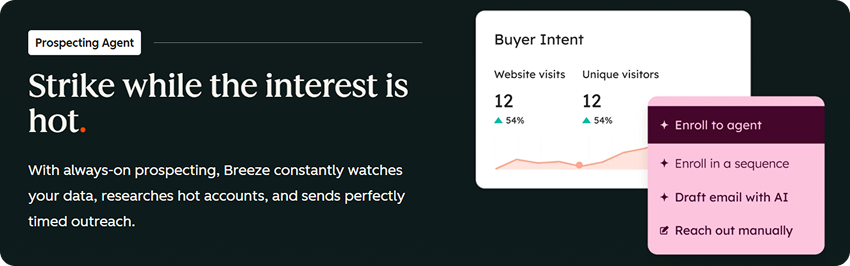
One example is HubSpot Prospecting Agent, which is designed to research contacts and support personalised outreach to help teams build a more efficient sales pipeline. Rather than asking reps to manually research every lead and draft every follow-up from scratch, it helps sales teams focus attention on higher-priority opportunities with better context and more consistent execution.
What this looks like in practice
For teams focused on growth, these kinds of updates can help:
-
surface higher-priority accounts and opportunities
-
reduce time spent on low-value admin
-
improve follow-up consistency
-
keep deal movement clearer after conversations
-
create better alignment between sales activity and CRM visibility
-
support more personalised outbound activity at scale
-
reduce research and drafting time for sales teams
What to check before rollout
Before prioritising this area, it is worth reviewing:
-
contact and company data quality
-
lifecycle stages and handoff logic
-
sales process consistency
-
CRM ownership and usage habits
- The structure of, and how current your product offering and category data are, and they are documented in your CRM (if not on eCommerce tools or automation)
-
how meetings, notes, and next steps are currently captured
If the foundation is weak, AI can amplify inconsistency rather than improve performance.
It is also worth remembering that tools like Prospecting Agent work best when there is already a clear sales process, strong data discipline, and sensible outreach guardrails in place. Used well, they can help teams move faster. Used too early, they can simply accelerate poor habits.
This is the most important but also the most difficult element most businesses are struggling with right now; how to gear up for and leverage AI, quickly. Your HubSpot and integrated platform data need to be more than in order, they need to be immaculate, otherwise AI produces error.
If you need to review your data model and restructure it quickly or run an audit of your HubSpot and integrated portal to do so, Book a meeting for us to discuss what this can look like.
Best fit for this priority
This area usually makes sense for:
-
sales-led businesses
-
teams with pipeline pressure
-
organisations trying to improve speed-to-follow-up
-
businesses wanting stronger CRM process alignment
Book a demo with Lupo to explore these features
Learn how to leverage these features to take full control and enhance your HubSpot Experience.


2. How to build awareness quicker for the AI age
Visibility is no longer only about ranking in traditional search. Buyers are discovering brands through more channels, more formats, and increasingly through AI-supported experiences that summarise, recommend, and surface content in new ways.
That is why Spring Spotlight themes tied to AEO and AI-assisted campaign planning matter.
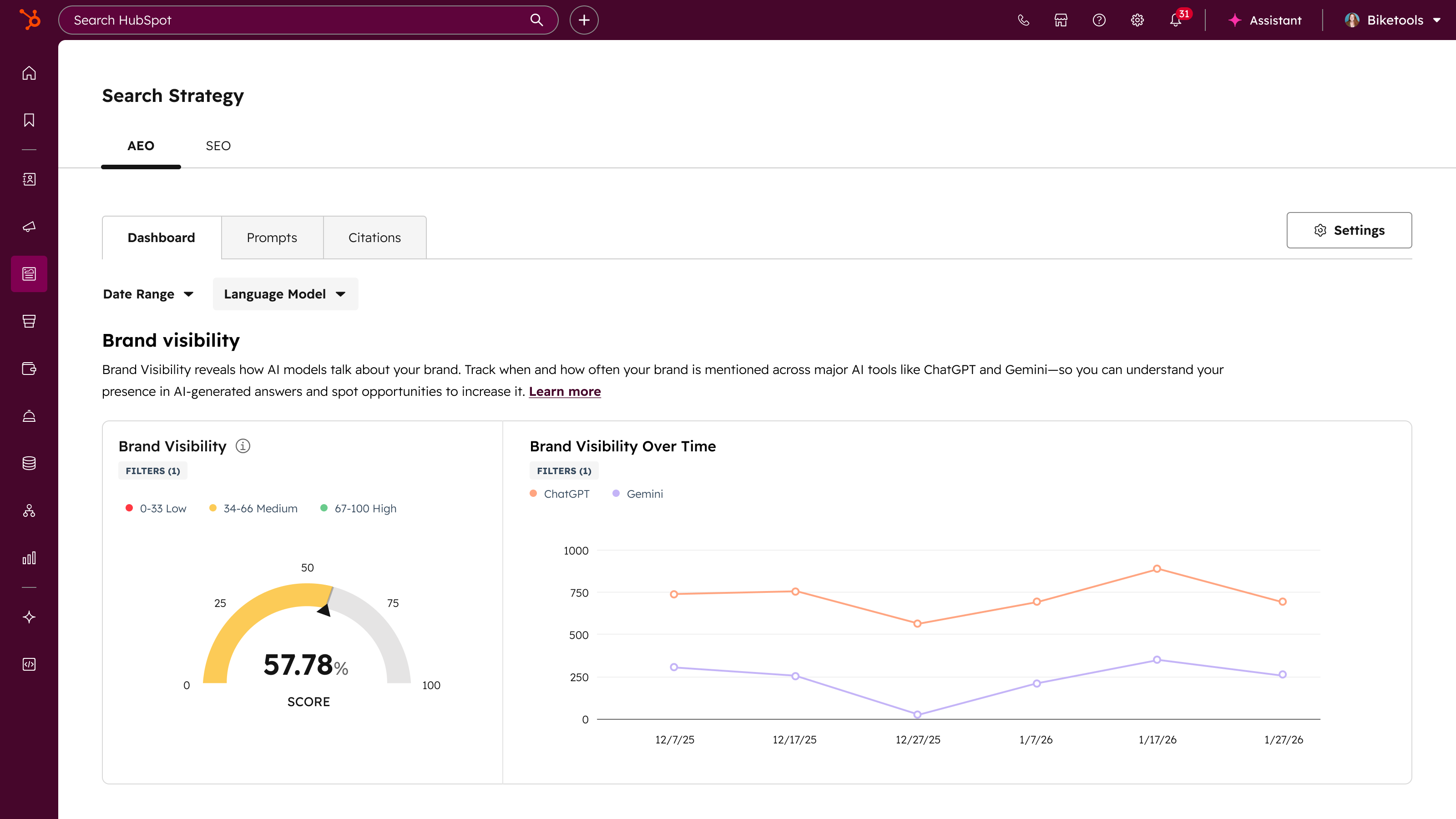
HubSpot’s AEO capability gives teams a way to measure how their brand appears in answer engine responses and track visibility, citations, and competitor presence over time. That matters because discovery is increasingly influenced by AI-generated answers, not just traditional rankings. For marketers, this creates a more practical way to assess whether their content is being surfaced, cited, and trusted in the environments where buyers are now asking questions.
What this looks like in practice
For marketing teams, this shift creates a more important content question:
are you producing content that is clear, structured, credible, and useful enough to be surfaced and trusted?
This can influence:
-
blog strategy
-
website content structure
-
pillar and cluster planning
-
campaign messaging
-
thought leadership positioning
-
how internal teams use AI during planning and production
- how often your brand appears in answer engine responses
- which content types and domains are earning citations
- where competitors are gaining more visibility in AI-driven discovery
What to check before rollout
Before going too far into this area, review:
-
how clear your current content architecture is
-
whether key service or product pages answer real buyer questions
-
whether your team has a repeatable content strategy
-
whether AI is being used with clear process and quality control
-
where your current authority and discoverability gaps sit
This is also an area where patience matters. AEO is not just another reporting layer. It is a signal about how your brand is being interpreted and cited across emerging answer engines, which means content quality, credibility, and consistency matter just as much as production speed.
Best fit for this priority
This area usually makes sense for:
-
marketing-led businesses
-
teams focused on demand generation
-
brands trying to improve discovery and authority
-
organisations building a stronger Human-Led, AI-First content model
Book a demo with Lupo to explore these features
Learn how to leverage these features to take full control and enhance your HubSpot Experience.
3. How to scale customer service and support more efficiently
Support teams are under ongoing pressure to respond faster, maintain quality, and do more without increasing internal complexity.
Spring Spotlight’s service-focused updates matter because they create new ways to handle routine enquiries while keeping human expertise where it matters most.
A clear example is Customer Agent, which is designed to handle customer questions automatically and reduce the load on support teams. HubSpot describes it as an AI-powered support specialist that can manage a large share of routine enquiries, helping teams spend less time on repetitive responses and more time on complex, higher-value customer interactions. It also differs from a basic chatbot by using CRM context and business knowledge to provide more relevant and personalised support.
There is also a useful service layer around reply recommendations, where support reps can use AI-generated answers based on synced knowledge sources and business content instead of relying on generic responses.
What this looks like in practice
For service teams, the opportunity is not just automation. It is creating a better support model:
-
faster first-response handling
-
better consistency for common questions
-
more space for internal teams to focus on complex issues
-
improved service coverage without unnecessary strain
- stronger use of existing knowledge and support content
- more contextual responses based on CRM and business knowledge
What to check before rollout
Before introducing this type of capability, teams should review:
-
the quality of existing knowledge sources
-
FAQ coverage
-
escalation logic
-
tone and customer experience expectations
-
which interactions should remain human-led
-
how success will be measured
The safest path is usually a clearly defined pilot rather than a broad launch.
For most businesses, this area works best when support content is already in reasonably strong shape. If your help content is inconsistent, incomplete, or outdated, AI-supported service tools may struggle to deliver the quality your customers expect.
Best fit for this priority
This area usually makes sense for:
-
service-heavy teams
-
businesses with repeatable support questions
-
teams trying to improve responsiveness
-
organisations ready to test Responsible AI in customer-facing workflows
.png?width=850&height=290&name=Customer%20Agent%20(2).png)
What should you prioritise first?
Not every update deserves immediate action.
A useful framework is to score each priority area against four questions:
1. Where is the business pressure right now?
Is the biggest issue pipeline, discoverability, support load, or internal efficiency?
2. What is the likely short-term win?
Which area could create a practical result in the next 60 to 90 days?
3. What foundation is already in place?
Do you have the CRM data, content structure, process quality, and team readiness needed?
4. What will your team actually adopt?
A smaller priority with strong adoption is often more valuable than a bigger initiative with weak follow-through.
In practice, this means the best first move is usually not the most exciting feature. It is the update your team is most ready to use well, with the clearest path to measurable value.
If revenue pressure is high, the sales-related changes may deserve earlier attention. If discoverability and demand generation are the bigger challenge, the awareness and content layer may be more urgent. If support capacity is already stretched, service improvements may create the fastest operational relief.
A practical rollout approach
For most teams, the best next step is not to tackle everything. It is to select one priority area and move through a structured rollout path:
Step 1: Review fit
Decide which update aligns best with your current goals.
Step 2: Check readiness
Assess data, process, content, team habits, and internal ownership.
Step 3: Pilot where possible
Start with a contained implementation or test environment.
Step 4: Enable the team
Support rollout with training, clear expectations, and practical usage guidance.
Step 5: Measure value
Track outcomes against a defined success goal.
That is the difference between having access to a capability and actually benefiting from it.
Get the practical guide
If you’d like help identifying what to focus on next, Lupo can help you map the right next step.
Where Lupo helps
This is the layer that often gets missed after a release.
HubSpot explains what is new. Lupo helps teams work out:
-
what is relevant
-
what should come first
-
what needs to be configured
-
what the rollout path should look like
-
how to support adoption across marketing, sales, and service
Our approach is practical, customer-centric, and data-driven. We help organisations turn product updates into actionable insights, clearer decisions, and rollout plans that fit the way their teams actually work.
Because the goal is not just to keep up with change.
It is to use change well.
For even more insight into HubSpot Spotlight 2026 check out What HubSpot’s Spring Spotlight 2026 Means for Growing Teams and What Existing HubSpot Users Should Focus on From Spring Spotlight 2026
Book a demo with Lupo to explore these features
Learn how to leverage these features to take full control and enhance your HubSpot Experience.

Written by Glenn Miller
An exceptionally experienced digital marketer, proactive and future-forward thought leader, I deliver exceptional customer experiences, industry leading digital strategy and superior marketing results.

